From Dramione to Malfoid: Why Fans Keep Rewriting Draco Malfoy
By Varenchat · November 3, 2026
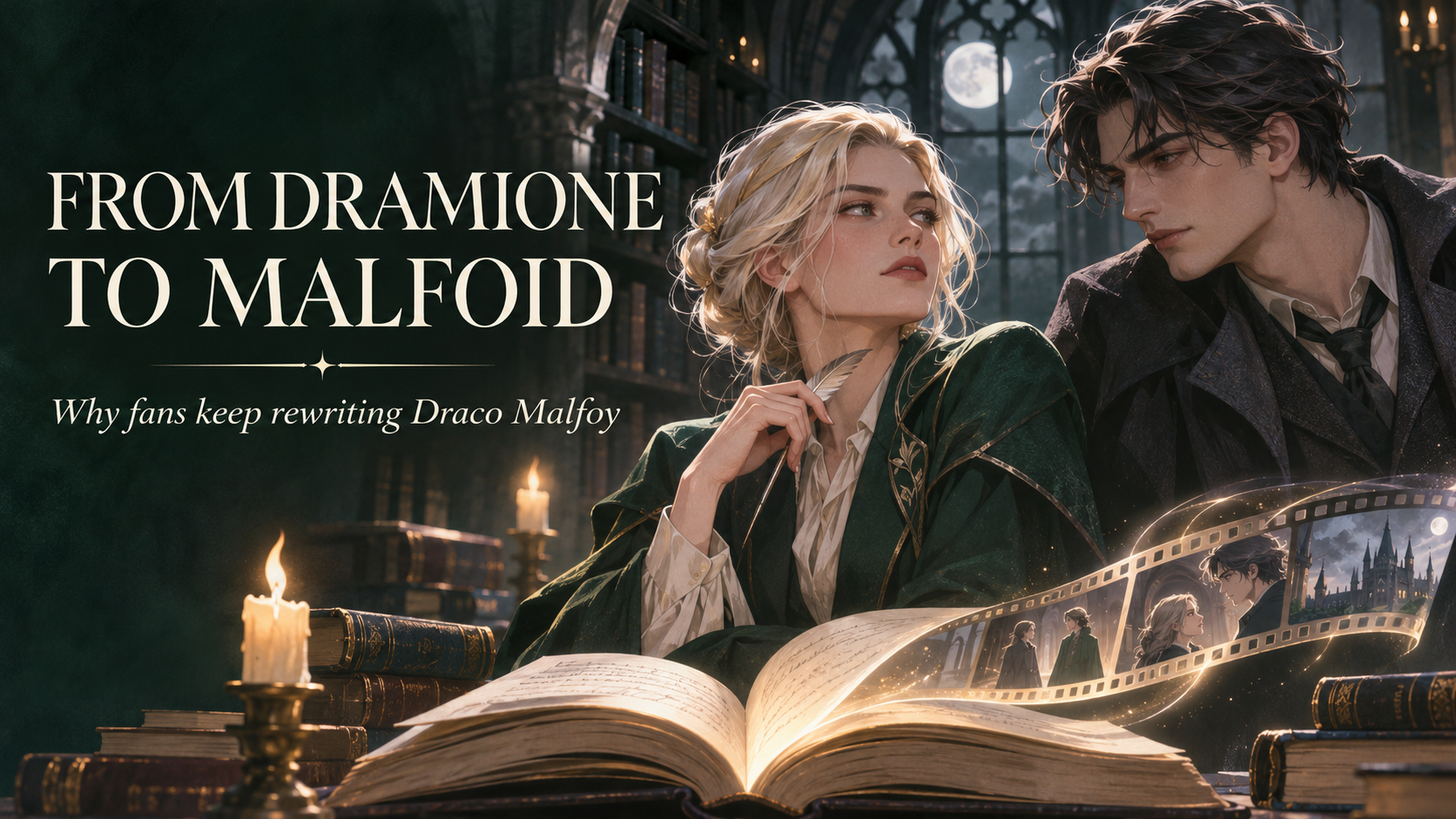
Draco Malfoy has had plenty of chances to fall in love outside the Harry Potter books. Fans have written him into relationships the original series never pursued, given him apologies he never made, and imagined what it would take for him to change. Some of those stories have kept readers occupied for years. Others have helped their authors make the move into traditional publishing. In autumn 2026, another version of Draco began appearing across social feeds: a blond, anime-style girl caught in a romance with Harry Potter.
Online, she is often called Malfoid. Draconia, Female Draco, and Miss Malfoy are other names you will encounter. The pale hair and Slytherin colors make her easy to place. So does the familiar preference for winning an argument over admitting a feeling. Each creator takes her somewhere different, though. A clip in your feed might belong to a continuing series, a standalone scene, or someone else's interpretation altogether.
There is an appealing tension here for anyone who enjoys a slow-burn romance. You recognize the difficult person in front of you, but you want to see what might make them behave differently. The audience can sense affection before either character is ready to acknowledge it. With AI-assisted animation, that gap can play out through a glance or a carefully timed pause. Meanwhile, the work's popularity brings questions about its origins and production into view.
For us at Varenchat, the interest is in how people keep finding new ways to spend time with characters. Dramione is reaching bookstore readers through rewritten novels; Malfoid is reaching viewers through illustrations and video. Those routes ask different things of their creators. Both begin with fans wanting more from a relationship than the original story gave them.
Dramione is the name for Draco and Hermione Granger as a romantic pairing. Drarry pairs Draco with Harry. Both have established fanfiction traditions, with plenty of variation within each. Malfoid generally names the gender-swapped character, often paired with Harry, rather than a single work. Knowing these distinctions helps when following links: a shared interest in Draco does not make the stories, or the communities around them, interchangeable.
Gender-swapped Draco artwork predates this wave. Automata's account of the trend traces the recent surge to REDTEN's September 22, 2026 illustration on X. The original post is available to view. It is an identifiable point in the current story, although tracing the earliest female Draco would require a much longer history of fan art. A widely shared drawing can renew interest in an idea that other fans have been exploring for years.
The latest videos can draw attention away from earlier artists. An illustration gives other creators something to respond to, and it continues to have a life of its own after animations appear. Viewers who arrive through a video deserve the chance to find that artwork and the person who made it. Following those connections is also a way to discover how different artists have interpreted the same idea.
Zey, posting as @ZeyHashimoto, has released Malfoid Won't Admit It: Episode 1, Episode 2, and Episode 3. Foyege's In Another Universe is another series, discussed in Creative Bloq's October 2026 coverage. J.A. Vázquez's Harry Potter × Malfoid | The Yule Ball runs approximately 33 minutes and identifies itself as an AI-made fan animation. There is no definitive order connecting these works. They belong to different creators.
That can be easy to miss when a clip turns up without context. Two similar-looking characters may have entirely different histories, so what looks like an abrupt personality change might simply be another author's version. Following the original account gives you the context and credits the person responsible. It also lets you discover whose storytelling you actually enjoy. A trending name can get you to the first video; a creator's particular sense of humor or handling of a scene gives you a reason to watch another.
The attention is substantial within the available snapshot. X API records retrieved on November 3, 2026, and included in the research brief supplied for this article, recorded approximately 394,000 posts for the query Malfoid over the preceding seven days. The query Dramione OR Drarry returned approximately 20,000 posts in the same window. In that dated API record, Zey's first episode had approximately 2.44 million impressions and 34,000 likes. These figures will change.
The counts measure posts matching those searches, not individual fans. Impressions also differ from unique viewers and completed video views. Other platforms and search terms fall outside the comparison, and the totals do not distinguish enthusiasm from criticism or curiosity. They show how much attention the Malfoid keyword was attracting on X at that moment. They cannot establish that one fandom has displaced another, much less tell us which stories people care about most.
Draco gives fan writers a lot to work with because readers see only part of his inner life. His pride and family expectations leave room for questions about what he believes and what he might eventually reconsider. A writer can decide which assumptions run deepest, then put him in a situation where keeping them becomes difficult. Another writer can make different choices and arrive at a different person. Recognizing the starting point is part of the pleasure of seeing how far a story takes him.
Enemies-to-lovers puts that process inside a relationship. Two people who disagree have reasons to pay attention to each other, even if neither enjoys admitting it. An argument reveals something that a polite introduction would conceal. An unexpected decision makes an easy judgment harder to maintain. Attraction becomes more convincing when both people have something to rethink. Readers get to watch their understanding change, including the awkward moments when one person notices it happening before the other does.
A persuasive apology can do more for this kind of romance than a beautiful character design. When someone has caused harm, the story needs to give the other person a reason to trust them again. Charm will only carry the scene so far. What happens afterward matters: whether the character behaves differently when the same pressure returns, or admits a mistake without expecting immediate forgiveness. Those choices can keep a relationship interesting well beyond its first moment of attraction.
Slow burn needs movement, even when a confession is still a long way off. One encounter might reveal a belief that will be hard to abandon. A private kindness might leave both characters unsure how to behave the next day. If every installment ends with them understanding each other exactly as well as before, the delay starts to feel mechanical. A small change can be enough, provided the reader gets to carry it into the next scene and wonder what it will make possible.
Dramione and Drarry give that change different histories. A Draco-and-Hermione story might work through ideas about status and worth, along with the personal history its author chooses to develop. A Draco-and-Harry story might examine how rivalry has shaped their assumptions about each other. Individual works vary enormously. Their appeal cannot be reduced to a formula in which hostility automatically becomes romance. The writer still has to make the particular relationship believable, with reasons for these people to choose each other.
Making Draco female changes those expectations again. Readers may interpret the same confidence or aggression differently in a woman, and a creator has choices about how to handle that. The anime-inspired version brings in the tsundere archetype: someone whose proud exterior makes affection difficult to express. An exaggerated reaction can communicate that contradiction quickly. Over a series, though, the character needs more to do than become embarrassed. Affection gets interesting when it interferes with something she believes, or forces a choice she would otherwise avoid.
There is room for comedy in all that self-consciousness. A character trying very hard to preserve their dignity can make a simple exchange absurdly complicated. The other person may know exactly what is happening, at least until it is their turn to be flustered. Giving both characters a chance to be perceptive and ridiculous keeps the relationship from feeling lopsided. The audience can enjoy the awkwardness while learning how the two people notice, misunderstand, and gradually become more generous toward each other.
Animation gives a creator control over the length of that awkward silence. A reader supplies their own timing to a written exchange; an illustration holds a particular moment still. A voiced, animated scene can let a response arrive too quickly, or make the audience wait for it. A remark that reads as dismissive can sound defensive in performance. What the character does immediately afterward may change how the whole line lands. These are useful possibilities for a story about feelings that people are trying to hide.
Imagine an original scene between two rival diplomats after a difficult negotiation. One stays behind to collect the other's scattered notes. On the page, the gesture could be practical, depending on how it is written. In an animated scene, the camera might linger after the papers are gathered. Neither person leaves quite as promptly as expected. Nothing much has happened, but the extra moment gives the viewer room to consider another explanation. The same action can suggest different things depending on how long we are allowed to look at it.
Editing can sharpen or undo that suggestion. Keep a reaction shot, and a harsh remark may reveal the uncertainty behind it. Cut away sooner, and the audience has less reason to reconsider its first impression. Music can encourage a romantic reading before the dialogue supports one. Generated footage still requires these decisions about how much the viewer should know. Leaving room for a second interpretation can be especially useful in a continuing story, where a later exchange may change the meaning of an earlier one.
Visual consistency is only part of the work. A character may have the same face in every shot and still feel unfamiliar because their behavior changes whenever the plot needs a romantic turn. Someone has to decide what they would actually say in this situation, and whether the surrounding scenes support it. A viewer may forgive an imperfect hand or an awkward movement more readily than an emotional leap that makes no sense. Smooth footage cannot supply the missing reason for a character to change their mind.
A short clip has little time to make that case. Familiar characters help by sparing viewers a lengthy introduction, and numbered episodes give an interested viewer somewhere to go next. Each installment still needs to contribute something they can use: perhaps a consequence of the previous encounter, or information that changes how they read it. A cliffhanger earns patience when the next scene develops what came before. Repeatedly stopping just before an answer can become tiring if the relationship underneath barely changes.
These works come from distributed creators using different combinations of tools. Automata's tutorial names Higgsfield, Vidu, Seedance, and Grok Imagine among tools credited around the trend. Higgsfield's About page locates its headquarters in San Francisco. A tool appearing in the wider discussion does not tell us which models produced a particular episode, or make its provider the producer of the work. For that, the creator's own credits are the place to look. Appearance and a tool's country of origin are poor substitutes for production information.
Even the name people search carries an argument with it. Automata describes Malfoid as a blend involving a derogatory term; the supplied research identifies that term as femoid. Some fans prefer Draconia or Female Draco for that reason. Malfoid remains useful for identifying this online trend, but readers should know why someone might be uncomfortable with it. Draconia offers a more neutral name for discussing the character without making that discomfort part of every mention.
Fans can love the same drawing and disagree about the language around it. Crediting its artist does not require adopting every term used to circulate it. There is room to explain where a name comes from and still choose another one in conversation. That seems a reasonable courtesy in a culture built around people taking different things from the same work. The word that makes something easiest to find need not determine how everyone talks about it afterward.
The gender swap also sits within a fandom with a long history of queer storytelling, including Drarry. A romance between Harry and a female Draco is one possibility among many, with its own creative choices to explore. Presenting it as a correction that makes the pairing acceptable would erase part of that history. The existence of another interpretation leaves the earlier ones available. A popular version can attract new readers and viewers without becoming the standard against which every other fan's story must be measured.
Draconia needs a life beyond being an interesting person for Harry to fall for. What would she care about if he were absent from the scene? A friendship might reveal a loyalty that never shows up during an argument with him. Family expectations could make an apparently simple decision difficult. Supporting characters with their own interests give those decisions consequences beyond the romance. They also give viewers something to care about while waiting for the central relationship to develop, so the story has places to go between confessions.
Fan creators are working with characters and settings whose rights belong to others. Describing a video as fanmade helps viewers understand its status, but the label does not itself grant permission. Commercial use and the rights to music or reference material still deserve attention, as does the amount of protected expression being borrowed. These are fan interpretations, with no official Harry Potter authorization or endorsement claimed in this article.
AI brings questions about both model training and the material used for a particular production. A viewer might recognize the drawing behind a character without knowing much about the model that animated it. A creator might name the model while leaving the source of a reference image unclear. Those gaps concern different stages of the process. Identifying an artist gives them credit for their contribution; it does not establish that they agreed to have a drawing used in a particular way. Clear information about both origin and permission makes the work easier to assess.
Creators can help by describing their tools and acknowledging the people whose work they used. Platforms can make those disclosures visible, and viewers can keep attribution attached when sharing. Following an original link is a small but useful way to preserve context. None of this settles every dispute over training data. It does give people something concrete to discuss, instead of asking them to judge the whole production from the polish of its final images.
Accusations about a particular creator also need evidence. Knowing that a video uses AI does not establish every detail of its production. It is perfectly possible to enjoy a scene and want better answers about how it was made. A viewer need not resolve every feeling into approval or rejection before saying what worked, what bothered them, or what remains unclear. That leaves space for criticism of the process alongside an assessment of the choices visible in the work.
The bookstore offers a different view of fan-created relationships reaching new audiences. In its September 23, 2025 feature, Harper's Bazaar discussed Alchemised, Rose in Chains, and The Irresistible Urge to Fall for Your Enemy, their connections to Dramione writing, and the substantial rewriting or reimagining involved in developing independent novels. These books give the fanfiction-to-publishing conversation something more specific to consider than the general idea of a popular pairing becoming commercially attractive.
The phrase filing off the serial numbers makes that work sound simpler than it is. Changing names leaves a writer with plenty to solve if the conflict depends on a familiar world's politics and history. Why do these people distrust each other now? What would changing sides cost them? An independent novel has to establish its own answers. Someone opening it without knowledge of the earlier fan work needs to understand the stakes well enough to care about the choices that follow.
That is a different task from introducing a recognizable Draco in a video. The fan creator can draw immediately on what the audience associates with him. The novelist building a new world has to earn those associations again, or replace them with something that serves the revised story. Both may be interested in a difficult person learning to love, but the amount of explanation needed will differ. A scene can feel charged before it starts when viewers already have a history with the characters.
Even within a fandom, that history varies. One viewer might bring years of favorite interpretations to a few seconds of footage. Another might arrive knowing very little beyond the original books. The creator cannot assume they will read the same gesture in the same way. An independent novel faces a similar problem with less shared context to draw on. What feels obvious to a longtime reader may need careful preparation for someone new. Adaptation involves deciding which meanings the story can carry over and which it must build for itself.
Length changes what that preparation can look like. A novel can return to a small choice hundreds of pages later. A short video may concentrate its effect in one exchange. Either can be emotionally precise or leave the audience unconvinced; running time alone tells us very little. The format works when it gives a scene enough room to do what it needs to do. A brief encounter can be satisfying on its own, while a series asks viewers to trust that its unresolved moments will lead somewhere.
Fans are free to move between all of these forms. An illustration might lead someone to a video, which might send them looking for a story to read. Others will stick with the medium they already enjoy. The X snapshot cannot tell us how often those journeys happen, and it gives no basis for declaring written fanfiction obsolete. For now, these examples offer different ways to return to a character, with different pleasures for the people making the trip.
Interactive storytelling adds the chance to answer back. During a difficult conversation, you can decide what your own character is willing to say. You might question a dismissive remark or decline a reconciliation that seems too easy. A response can make the scene more awkward, or open a conversation that would otherwise end. For people who enjoy the uncertainty of a developing relationship, having a say in that pace is an appealing way to spend time with it.
In Varenchat, you choose an original character and help shape an interactive roleplay story through conversation. Your responses contribute to what happens next. If the part you enjoy most is the hesitation before an admission, you can spend time in that exchange, deciding how much your own character is ready to reveal. A difficult answer can give you something to explore in the next scene, even when it leaves the romance unresolved.
An original setting leaves plenty of room for the same interest in difficult relationships. Begin with a disagreement that matters to both people. Our imagined diplomats, for example, might agree about whom a treaty should protect and disagree sharply about how to do it. Neither has to abandon a serious position just because they find the other person attractive. Their conversations can reveal why they hold those positions, and whether a better understanding makes cooperation possible. The romance has something substantial to develop alongside.
Progress can be quieter than a confession. A question gets an honest answer at last. An invitation is declined, but the response leaves both people clearer about what they want. These outcomes can be satisfying even when they postpone the romantic payoff. In roleplay, you also get to consider how your character handles disappointment. Their next response can reflect what they have learned, or reveal something they are still struggling to accept. That gives the exchange a history beyond the wish for a particular ending.
A character might offer help while still being unwilling to apologize. They might admit fault without agreeing on a solution. You decide what your own character makes of that and whether to leave room for another conversation. The uncertainty gives you something to write into. It allows affection to develop alongside the disagreement, with moments of understanding that do not require either person to become uncomplicated overnight.
If that sounds like a story you would enjoy spending time in, explore Varenchat's original characters and choose where to begin. The app is available on the App Store and Google Play. Find someone whose outlook gives you a reason to respond. You can leave the confession for another conversation.
Source note: Engagement figures are approximate and dated November 3, 2026. The seven-day post totals and episode API metrics come from the supplied research brief; the API queries were not independently rerun for this article. Linked public pages were checked during preparation. This article is cultural commentary from Varenchat and is not affiliated with or endorsed by the Harry Potter rights holders or the featured fan creators.